
Why do people continue to engage in the use of harmful substances despite knowing its associated health risks?
By Rick Liu, July 2026
Abstract
What is drug addiction? (National Institute on Drug Abuse, 2018)
Drug addiction is a chronic disease that impairs an individual's physiological and psychological functioning, often causing a loss of control over drug-seeking and drug-taking behaviours despite significant health risks. In most cases, drug addiction develops through the use of illicit or recreational drugs. Therefore, this article will focus on recreational drugs as a major contributor to addiction and its associated health consequences.
Before examining why individuals continue to abuse drugs despite the known risks to their health, it is important to first understand the different types of drugs, their effects on the body, and the potential dangers they pose to users.
Discussion
Types of Drugs (Mann, 2016)
Recreational drugs are substances that are used for non-medical purposes, either legally or illegally, without professional medical supervision or intervention.
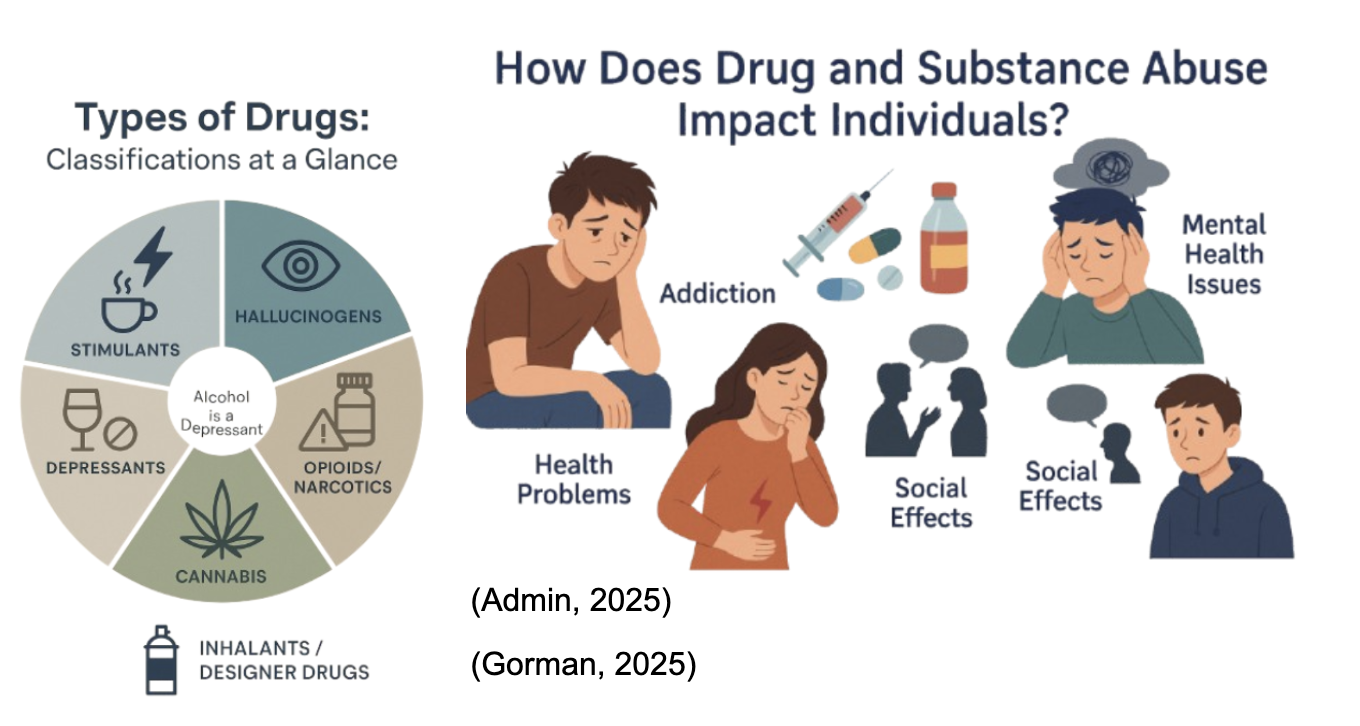
These drugs can be broadly classified into four main categories:
Depressants – substances that slow the activity of the central nervous system (CNS), which consists of the brain and spinal cord.
Hallucinogens – substances that alter perception and sensory experiences, affecting senses such as vision, hearing, smell, taste, and touch.
Stimulants – substances that increase the activity of the central nervous system, resulting in heightened alertness and energy levels.
Analgesics – substances that relieve pain by blocking or reducing pain signals within the central and peripheral nervous systems.
Although analgesics are primarily used for medicinal purposes, certain analgesic drugs may also be used recreationally, which can lead to misuse and dependence.
Note: there are more common groups of drugs, however these are the main categories where most drugs fall under
Depressants (Mann, 2016), (Health, 2019)
Depressants slow down the communication between the brain and the rest of the body; this could affect an individual’s concentration, coordination and self-awareness.
Small doses can induce, but are not limited to, a relaxed sensation and reduced inhibition.
Larger doses can induce, but are not limited to, sleepiness, vomiting and nausea, unconsciousness and death.
Hallucinogens (Mann, 2016), (Health, 2019)
Hallucinogens alter an individual’s perception of reality, thus inducing hallucinations. Senses (see, hear, taste, smell) can become distorted, where an individual may see or hear things that are not real, or have unusual thoughts or feelings.
Small doses can induce, but are not limited to, a feeling of floating, numbness, confusion, disorientation, or dizziness.
Larger doses can induce, but are not limited to, hallucinations, memory loss, distress, anxiety, increased heart rate, paranoia, panic and aggression.
Stimulants (Mann, 2016), (Health, 2019)
Stimulants speed up the communication between the brain and body, affecting an individual’s overall physiological response.
Small doses can induce, but are not limited to, increased heartbeat, increased blood pressure, increased body temperature, reduced appetite, agitation and sleeplessness.
Larger doses can include, but are not limited to, anxiety, panic, seizures, stomach cramps and paranoia.
Associated health risks with the use of drugs (National Institute on Drug Abuse, 2020)
The effects of recreational drugs vary considerably depending on the type of substance consumed. Individuals with drug addiction often experience one or more associated health problems, including heart disease, lung disease, stroke, cancer, and mental health disorders. Drug use can also increase the risk of contracting infectious diseases, as impaired judgement and reduced inhibitions may lead to unsafe behaviours.
Drug use and mental illness frequently coexist. Individuals suffering from conditions such as anxiety, depression, or schizophrenia may turn to drugs for either medicinal relief or recreational purposes, increasing their risk of developing an addiction. Furthermore, drug use can trigger the onset of mental health disorders or worsen existing symptoms. For example, a person may initially use drugs to alleviate psychological distress but subsequently develop a dependence on the substance.
The consequences of drug addiction extend beyond the individual user and can negatively affect others. These consequences include exposure to second-hand drug consumption, such as passive smoking, an increased risk of spreading infectious diseases, and a greater likelihood of motor vehicle accidents caused by impaired judgement and coordination.
(Admin, 2025)
(Gorman, 2025)
What happens to the physiology of an individual who consumes drugs? (National Institute on Drug Abuse, 2018)
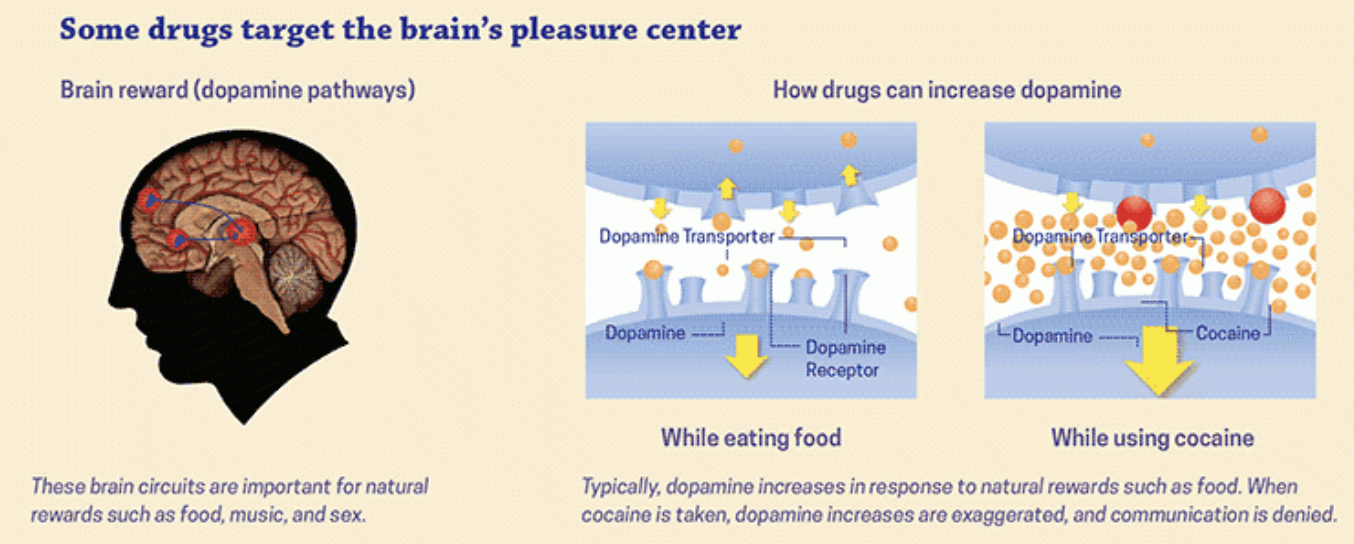
Beyond the immediate symptoms and health risks associated with drug use, many drugs directly affect the brain's reward system. These substances can produce intense feelings of euphoria by triggering the release of dopamine, a neurotransmitter involved in pleasure, motivation, and reward. The resulting surge in dopamine reinforces the behaviour, motivating the individual to continue using the drug in order to experience the same pleasurable sensation. Over time, this cycle can develop into drug addiction, exposing the individual to the harmful physical and psychological effects of the substance.
As drug use continues, the brain gradually adapts to the repeated increases in dopamine. To compensate, the cells within the reward system become less responsive to the neurotransmitter. This process, known as tolerance, causes individuals to require increasingly larger doses of a drug to achieve the same effect that was once produced by a smaller amount. As tolerance develops, the brain may also become less responsive to naturally rewarding activities, such as socialising, exercising, or spending time with friends and family.
In addition to altering the brain's reward circuitry, drug addiction can disrupt other important neural systems responsible for learning, memory, judgement, decision-making, stress regulation, and behaviour. These changes can impair an individual's ability to make rational decisions and resist cravings. As a result, many people continue to seek and use drugs despite being fully aware of the significant health risks and negative consequences associated with their addiction.
(National Institute on Drug Abuse, 2020)
Why do people continue to use drugs despite its health risks? (Health, 2019) (Alcohol and Drug Foundation, 2024)
Although education about the risks of drug use and its associated health consequences has become increasingly widespread, many individuals continue to engage in the use of harmful substances. This behaviour may be influenced by a variety of factors, including:
Curiosity and experimentation
Peer pressure and social influence
Enjoyment of the drug's effects, such as relaxation or pleasure
Coping with physical or psychological pain
Relieving stress or anxiety
Overcoming boredom
Drug dependence and the avoidance of withdrawal symptoms
Many people initially use drugs because they perceive the benefits to outweigh the potential risks. For example, some individuals may use substances to temporarily relieve emotional distress, trauma, or psychological pain, while others may seek the feelings of euphoria and reduced inhibition that certain drugs can produce. In these situations, the immediate rewards of drug use may appear more significant than the potential long-term consequences.
For some individuals, repeated drug use gradually develops into addiction, while for others, dependence can begin after only a small number of uses. Once addiction develops, it becomes increasingly difficult to break the cycle of drug-seeking behaviour due to the changes that occur within the brain.
As drug use continues, the brain develops tolerance to the repeated surges of dopamine associated with substance use. Consequently, the pleasurable effects of a given dose diminish over time, leading individuals to consume larger amounts of the drug or use it more frequently in order to achieve the same effect. This process intensifies cravings and reinforces addictive behaviour, often resulting in severe physiological, psychological, and social consequences. Despite being aware of these risks, individuals may continue using drugs because the neurological changes associated with addiction significantly impair their ability to resist cravings and make rational decisions.
Conclusion
Like many chronic diseases, drug addiction cannot always be completely cured. However, it is a treatable condition that can be effectively managed with appropriate intervention. Although individuals who have recovered from addiction remain at risk of relapse, a combination of medication-assisted treatment and behavioural therapy can significantly improve the likelihood of long-term recovery. As patterns of drug use and the severity of addiction vary between individuals, treatment approaches are often tailored to meet each person's specific needs.
In summary, recreational drugs can profoundly alter the physiology of the body, particularly the central nervous system, leading to changes in brain function that reinforce continued drug use and addiction. These neurological adaptations help explain why many individuals continue to use drugs despite being aware of the associated health risks. Nevertheless, with appropriate treatment, ongoing support, and guidance from healthcare professionals, individuals can successfully manage addiction and work towards recovery.
Bibliography:
https://www.bmj.com/content/353/bmj.i2775/rr
https://www.health.gov.au/topics/drugs/about-drugs/what-are-drugs?language=en
https://nida.nih.gov/publications/drugfacts/understanding-drug-use-addiction
https://adf.org.au/talking-about-drugs/family-and-friends/why-people-use/
https://www.health.gov.au/topics/drugs/about-drugs/types-of-drugs?language=en
https://nida.nih.gov/publications/drugs-brains-behavior-science-addiction/addiction-health
https://nida.nih.gov/publications/drugs-brains-behavior-science-addiction/drugs-brain
This Article is written by our volunteer student research team at Feel Every Beat, and is intended for educational purposes only. It is not a substitute for professional medical advice.
